In various sections we will discuss object-oriented programming and its characteristics, general questions regarding Java and its functionality, collections in Java, garbage collectors, exception handling, Java applets, Swing, JDBC, Remote Method Invocation (RMI), Servlets and JSP.
Showing posts with label Java eBook. Show all posts
Thursday, June 11, 2015
Free eGuide: Java Interview Questions and Answers
In various sections we will discuss object-oriented programming and its characteristics, general questions regarding Java and its functionality, collections in Java, garbage collectors, exception handling, Java applets, Swing, JDBC, Remote Method Invocation (RMI), Servlets and JSP.
Wednesday, June 10, 2015
Free eGuide: "Getting Started with Java EE Security"
These capabilities include authentication, authorization, data integrity and transport security. Other topics covered in this Refcard include Web Module, EJB and Application Client security, securing Java EE Web Services, Hot Tips and more. Highly recommended reading for Java EE users and Java enthusiasts of all kinds.
Contents Include:

Contents Include:
- Security in Java EE Applications
- Web Module Security
- EJB Module Security
- Application Client Security
- Securing Java EE Web Services
- Hot Tips and more …
Monday, June 8, 2015
Free eGuide: The Essential Debugging JavaScript Cheat Sheet
Contents Include:
Basics
- Common Problems
- Debugging JQuery
- Mobile Debugging
- Debugging Tools … and More!
Refcardz are FREE cheat sheets made just for developers. It’s the easy way to stay on top of the newest technologies!
Tuesday, October 14, 2014
Free eGuide: "JVM Troubleshooting Guide"
"JVM Troubleshooting Guide"
The Java virtual machine is really the foundation of any Java EE platform.
The Java bytecode produced when application are compiled, is eventually executed by the Java Virtual Machine (JVM). The JVM has grown to be a sophisticated tool, but it essentially remains a "black box" for most Java programmers. This is especially true when problems and issues arise from its erroneous use.
With this free eBook you will also receive weekly news, tips and special offers delivered to your inbox courtesy of Java Code Geeks.
Sunday, October 12, 2014
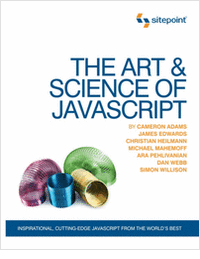
Free eBook: "The Art & Science of JavaScript"
For intermediate JavaScript developers who want to take their JavaScript skills to the next level without sacrificing web accessibility or best practice.
If you've never written a line of JavaScript before, this probably isn't the right book for you—some of the logic in the later chapters can get a little hairy. If you have only a small amount of experience with JavaScript, but are comfortable enough programming in another language such as PHP or Java, you'll be just fine—SitePoint will hold your hand along the way, and all of the code is available for you to download and experiment with on your own. And if you're an experienced JavaScript developer, they would be very, very surprised if you didn't learn a thing or two. In fact, if you only learn a thing or two, you should contact them at SitePoint—they may have a book project for you to tackle!
Free eBook: "jQuery Hotshot -- Free 32 Page Excerpt"
It has become the standard tool for web developers and designers to add dynamic, interactive elements to their sites, smoothing out browser inconsistencies and reducing costly development time.
jQuery Hotshot walks you step by step through 10 projects designed to familiarise you with the jQuery library and related technologies. Each project focuses on a particular subject or section of the API, but also looks at something related, like jQuery's official templates, or an HTML5 feature like localStorage. Build your knowledge of jQuery and related technologies.
Learn a large swathe of the API, up to and including jQuery 1.9, by completing the ten individual projects covered in the book.
Some of the projects that we'll work through over the course of this book include a drag-and-drop puzzle game, a browser extension, a multi-file drag-and-drop uploader, an infinite scroller, a sortable table, and a heat map.
Learn which jQuery methods and techniques to use in which situations with jQuery Hotshots.
Packt Enterprise books can be summed up through the tagline "Professional Expertise Distilled". They take in-the-trenches knowledge from experienced software professionals, and distil it into a single, easy to follow manuscript.
- See more at: http://jobsinsciences.tradepub.com/free/w_pack46/#sthash.PwXEhVJj.dpuf
Wednesday, October 8, 2014
Free eBook: JavaScript Programming: Pushing the Limits (Expert)
Take your JavaScript knowledge as far as it can go
JavaScript has evolved into much more than simple client-side scripting; this book delves into advanced topics not generally found in other more intermediate JS development books
Expert author delivers an in-depth tutorial showing how to build a real-world app that is loosely coupled, with each component built to exist separately
Explores how to build a backbone app, the importance of JavaScript templates, Node.js and MongoDB, 3D Canvas using WebGL / Three.js, how to convert a desktop app into a dedicated mobile app, and much more
Ideal for experienced developers with a deep knowledge of JavaScript as well as online developers with strong graphic design skills who are experienced in HTML/CSS and want to develop their front-end skills
JavaScript Programming: Pushing the Limits will arm you with the skills to create killer apps for the 21st Century.
Free eGuide: Bulletproof Java Code: A Practical Strategy for Developing Functional, Reliable, and Secure Java Code
Use Java? If you do, you know that Java software can be used to drive application logic of Web services or Web applications. Perhaps you use it for desktop applications? Or, embedded devices? Whatever your use of Java code, functional errors are the enemy!
To combat this enemy, your team might already perform functional testing. Even so, you're taking significant risks if you have not yet implemented a comprehensive team-wide quality management strategy. Such a strategy alleviates reliability, security, and performance problems to ensure that your code is free of functionality errors.
Read this article to learn about this simple four-step strategy that is proven to make Java code more reliable, more secure, and easier to maintain.
Monday, August 11, 2014
Free eBook: PHP, MySQL, JavaScript & HTML5 All-in-One For Dummies (Expert)
Get the basics on four key web programming tools in one great book!
Addresses how PHP, MySQL, JavaScript, and HTML5 are vital tools for creating dynamic, database-driven websites and are especially important for e-commerce sites
Serves as essential reading for web designers who are new to these technologies, offering a crash course covering all of these powerful technologies in this handy volume of seven self-contained minibooks
Covers how to program in PHP and how to create and administer a MySQL database as well as how to manipulate MySQL data via a web interface
Shows how to create a secure website and how to code popular e-business applications such as login programs and shopping carts
With seven books in one, PHP, MySQL, JavaScript & HTML5 All-in-One For Dummies will turn your website into the center of attention in no time at all.
Monday, July 28, 2014
InfoWorld's Java IDE Free Comparison Strategy Guide
Find out why CodeGear was named Best Java IDE.
If you're looking for a Java IDE, you want one based on Eclipse. But which offering do you want? Download the Infoworld Java IDE Comparison Strategy Guide. In this three-part guide we'll go deep into the details, comparing Technology of the Year winner JBuilder 2007, IBM's IRAD, MyEclipse and the free open-source Eclipse platform.
We close this Java IDE Strategy Guide with a look at an advanced concept in Java development: Application Factories. This innovative development metaphor and associated collection of tools allows developers to focus more on the nature and purpose of the application, and less on the underlying platform, framework, and technologies being used.
This strategy guide is written by InfoWorld, Compliments of CodeGear
Friday, July 25, 2014
Free eGuide: JVM Troubleshooting Guide
The Java virtual machine is really the foundation of any Java EE platform.
The Java bytecode produced when application are compiled, is eventually executed by the Java Virtual Machine (JVM). The JVM has grown to be a sophisticated tool, but it essentially remains a "black box" for most Java programmers. This is especially true when problems and issues arise from its erroneous use.
With this guide, you will delve into the intricacies of the JVM and learn how to perform troubleshooting and problem resolution.
With this free eBook you will also receive weekly news, tips and special offers delivered to your inbox courtesy of Java Code Geeks.
Free 150 Page eBook: 'Simply JavaScript'
Packed with full-color examples, Simply JavaScript is all you need to start programming in JavaScript the right way.
Learn how easy it is to use JavaScript to solve real-world problems, build smarter forms, track user events (such as mouse clicks and key strokes), and design eye-catching animations. Then move on to more powerful techniques using the DOM and Ajax. World-renowned authors, Kevin Yank and Cameron Adams have used their exquisite skills and in-depth knowledge of JavaScript to deliver a book that teaches JavaScript with unprecedented clarity.
Thursday, July 24, 2014
Free 599 Page eBook: Java Application Development on Linux
"Java™ Application Development on Linux® - Free 599 Page eBook"
Linux is the fastest-growing Java development platform because it saves money and time by serving as a platform for both development and deployment. But developers face significant platform-specific challenges when managing and deploying Java applications in a controlled production environment.
Written for Java and Linux developers alike, Java� Application Development on Linux® is the hands-on guide to the full Java application development lifecycle on Linux.
Determined to spare other developers hours of trial and error, Albing and Schwarz demonstrate the platform, tools, and application development by showing realistic, easy-to-follow examples. After a simple command-line application introduces basic tools, this program leads readers through business-logic object analysis, database design, Java servlet UIs, Java Server Pages (JSP) UIs, Swing GUIs, and Standard Widget Toolkit (SWT) GUIs. Scaling up to the enterprise level provides the opportunity to use both the JBoss Application Server and the Apache Geronimo Application Servers, and Enterprise JavaBeans (EJB).
Readers learn how to:
The authors conclude by demonstrating how a hierarchy of budgets can be created, tracked, and shared with Concurrent Versions System (CVS). Java� Application Development on Linux® can propel you from a standing start to the full-speed development and deployment of Java applications on Linux.
By Carl Albing, Michael Schwarz. Published by Prentice Hall. Part of the Bruce Perens' Open Source Series.
Offered Free by: informIT
Linux is the fastest-growing Java development platform because it saves money and time by serving as a platform for both development and deployment. But developers face significant platform-specific challenges when managing and deploying Java applications in a controlled production environment.
Written for Java and Linux developers alike, Java� Application Development on Linux® is the hands-on guide to the full Java application development lifecycle on Linux.
Determined to spare other developers hours of trial and error, Albing and Schwarz demonstrate the platform, tools, and application development by showing realistic, easy-to-follow examples. After a simple command-line application introduces basic tools, this program leads readers through business-logic object analysis, database design, Java servlet UIs, Java Server Pages (JSP) UIs, Swing GUIs, and Standard Widget Toolkit (SWT) GUIs. Scaling up to the enterprise level provides the opportunity to use both the JBoss Application Server and the Apache Geronimo Application Servers, and Enterprise JavaBeans (EJB).
Readers learn how to:
- Use development tools available on Linux, such as the GNU Compiler for Java (gcj), Ant, the NetBeans IDE, IBM's Eclipse Java IDE, JUnit, and SunONE Studio
- Develop business logic layers using Java DataBase Connectivity (JDBC)
- Add a Web interface using servlets and JSPs
- Add a GUI using Sun's Abstract Window Toolkit (AWT) and IBM's SWT
- Deploy EJBs in Linux
The authors conclude by demonstrating how a hierarchy of budgets can be created, tracked, and shared with Concurrent Versions System (CVS). Java� Application Development on Linux® can propel you from a standing start to the full-speed development and deployment of Java applications on Linux.
By Carl Albing, Michael Schwarz. Published by Prentice Hall. Part of the Bruce Perens' Open Source Series.
Offered Free by: informIT
Subscribe to:
Posts (Atom)